

Gaganyaan
- 19th Jan 2026
- Author: David Southworth
The Indian Human Spaceflight Programme, using the Gaganyaan spacecraft, should see India become the fourth country to launch humans into space. Gaganyaan-1, the first uncrewed orbital test flight, is currently planned to launch early in 2026.
Background
The national space agency of India – now known as the Indian Space Research Organisation (ISRO) – has been launching rockets to space since 1967. India became the seventh country to achieve orbital flight with a successful ISRO deployment of a satellite in 1980. Through the following decades, India continued to launch satellites into orbit, and is now one of the leading countries operating satellites, including those for communication, earth observation and position fixing.
ISRO has also worked on the development of more powerful rockets, allowing longer distance spaceflights, and in recent years has achieved a number of prominent milestones in space exploration.
- In 2008, the Chandrayaan-1 mission went into lunar orbit and released a probe that achieved a controlled impact on the Moon’s surface. That mission confirmed the existence of water ice in the region around the lunar south pole.
- In 2014, the Mangalyaan mission, or Mars Orbiter Mission, entered Martian orbit, making India the first country to achieve such an orbit on its first attempt.
- In 2023, the Chandrayaan-3 mission achieved the first ever soft landing close to the lunar south pole, deploying a rover that made further measurements in that region.
Indian human spaceflight
Through much of the 21st Century, ISRO officials had informally suggested an aim of putting humans into space, and in 2018 the announcement of the Indian Human Spaceflight Programme formalised this objective.
The first Indian national to have undertaken an orbital spaceflight was Rakesh Sharma, who spent 7 days on the Salyut 7 space station in 1984 as part of the Soviet Interkosmos programme. In addition, three astronauts of Indian origin have flown with NASA – Kalpana Chawla (an Indian-born American citizen, who tragically died in the 2003 Columbia disaster), and Sunita Williams and Raja Chari (both American-born with Indian heritage). In recent years, one Indian national - Gopi Thotakura - and four more people of Indian descent have flown on sub-orbital flights as space tourists.
Sovereign spaceflight
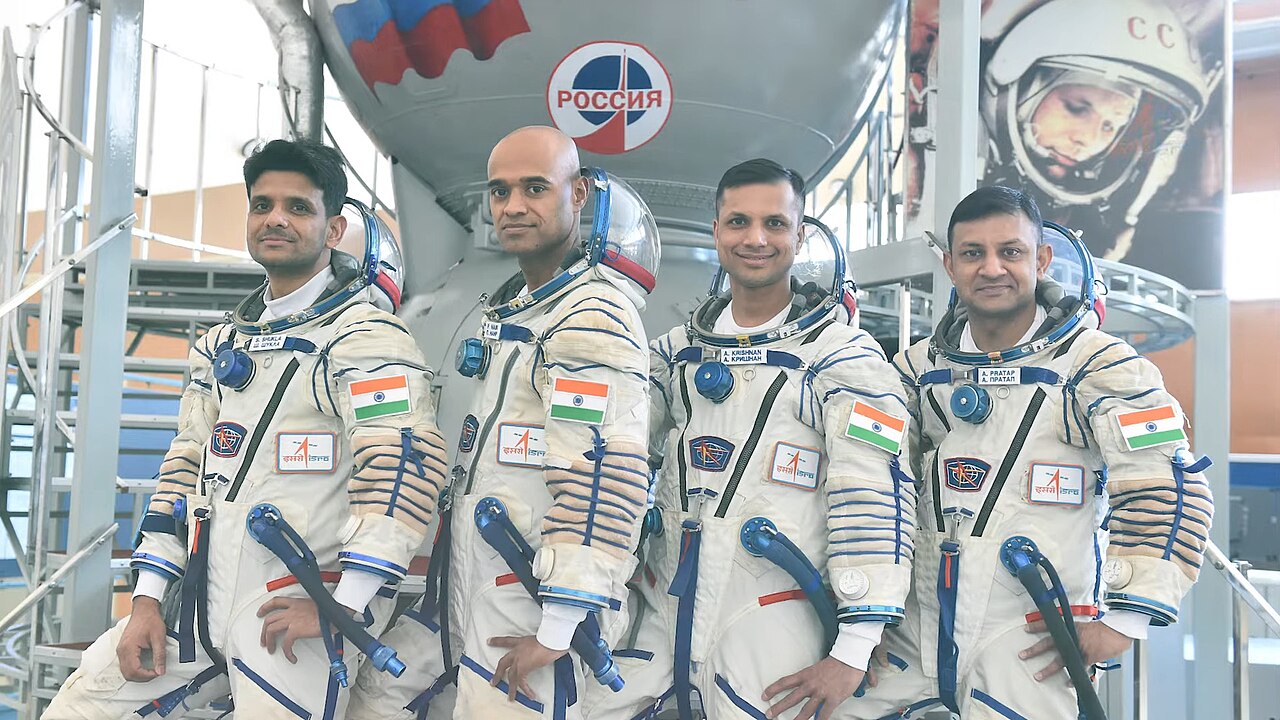
The Gaganyaan mission (from Sanskrit, meaning “celestial craft”) will see this number increase. In February 2024 the first four designated astronauts were announced – Prasanth Nair, Ajit Krishnan, Angad Pratap, and Shubhanshu Shukla, all test pilots in the Indian Air Force. Prior to the announcement they had already been in training for several years, initially in Russia and subsequently back in India.
The crew of the first planned crewed mission – Gaganyaan-4 – will be taken from this group. And one them – Shubhanshu Shukla – has already become the second Indian national to orbit the Earth, spending nearly three weeks on board the International Space Station on Axiom Misssion 4 in June and July 2025. During that mission, he was able to undertake experiments developed in India and co-ordinated by ISRO, as well as gain important practical experience of the logistics of an orbital spaceflight.
Vyommitra
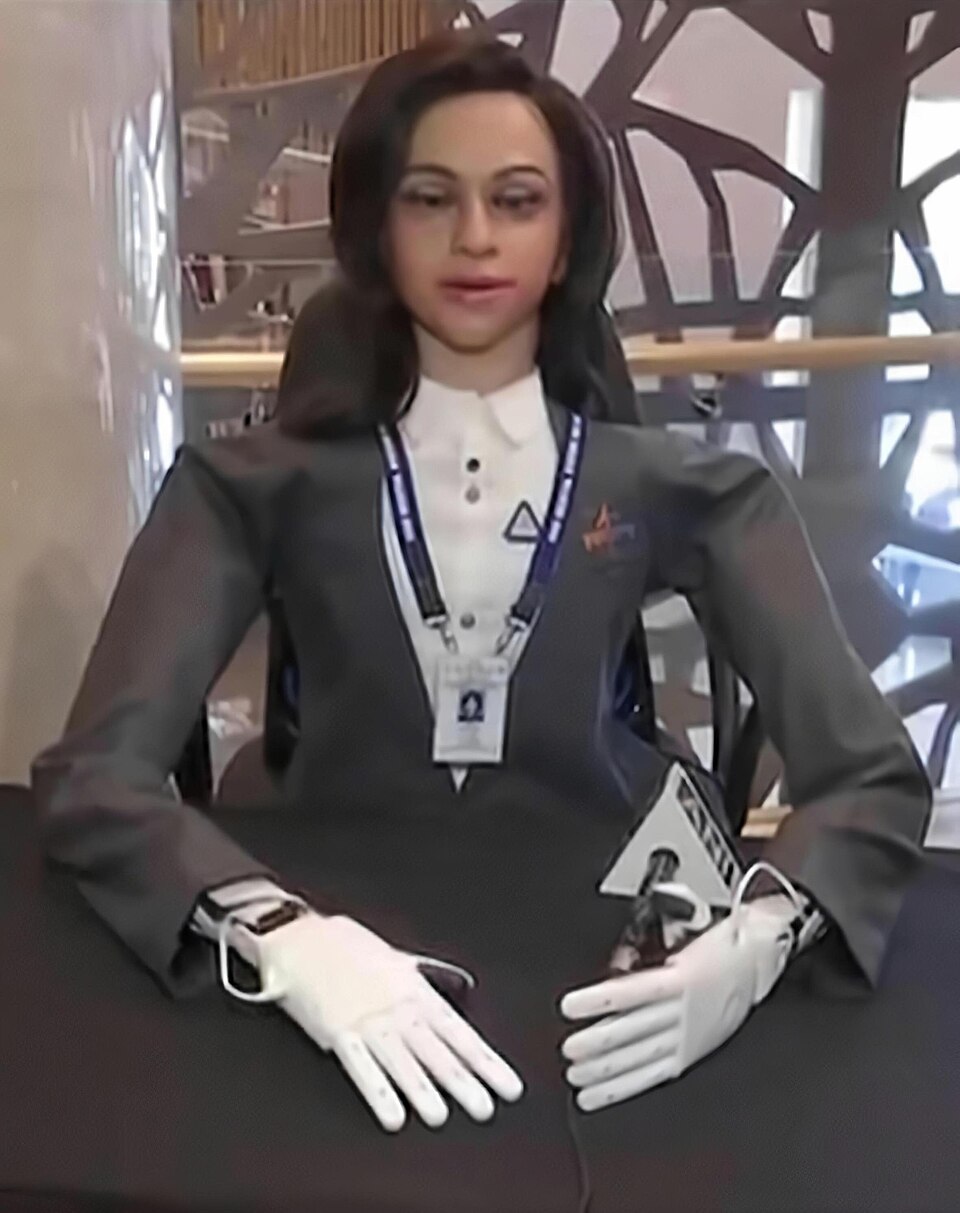
In contrast with other countries, the ISRO is keen to avoid using animals in preparation for human spaceflight. Instead, Gaganyaan-1 will have a humanoid robot on board, called Vyommitra (from Sanskrit, meaning “space friend”). This robot will include sensors to feed back information on the expected effects on the human body, but is also intended to perform experiments in microgravity, and undertake operations such as controlling life support systems on later crewed flights.
The LVM3 rocket
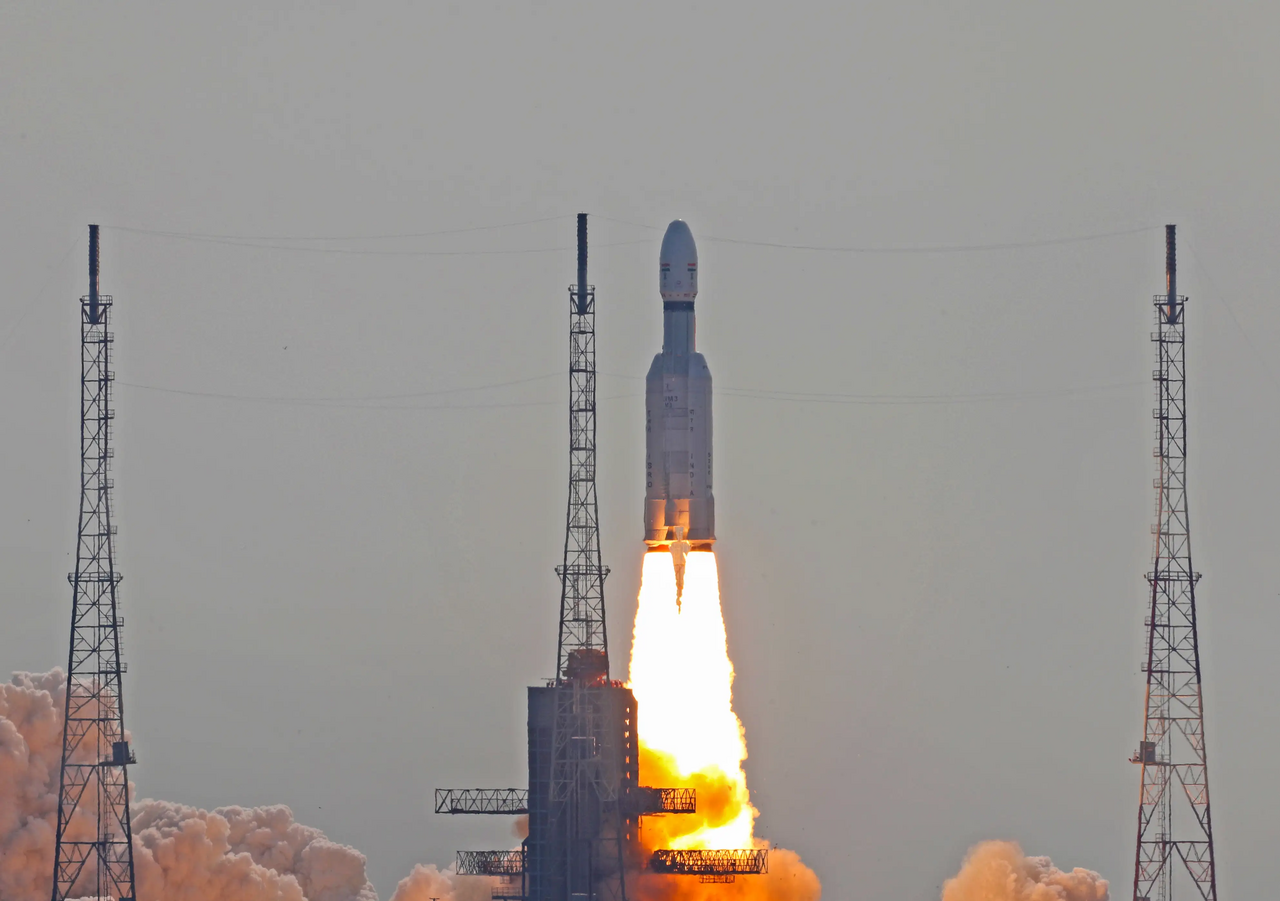
The Gaganyaan mission will be using an upgraded version of the Launch Vehicle Mark-3 or LVM3 rocket. The first test flight of the LVM3 was in 2014, with a total of nine launches since, experiencing a 100% success rate. Although not needed for its flights so far, the LVM3 was designed with sufficient weight capacity and acceleration limits to allow human spaceflight, with an eye to its future use. The rocket is currently undergoing the process of human-rating certification, ensuring that reliability and strength parameters meet the tighter criteria required for human spaceflight. Gaganyaan-1 will see the first test flight of the human-rated version of the rocket – the HLVM3. Missions will launch from the Satish Dhawan Space Centre, located on the island of Sriharikota in the state of Andhra Pradesh in the south east of India.
Future plans
Beyond the Gaganyaan mission, ISRO plans to put a space station in orbit – the Bharatiya Antariksh Station. Current plans would see the first module put into orbit in 2028, with the station due to be completed by 2035. Should these plans go ahead, it would certainly cement India’s position as an increasingly important player in space exploration, particularly given the expected demise of the International Space Station around 2030.
Full references / credits:
(Banner) The astronauts in the Gaganyaan programme. Credit: ISRO, 2024, Gaganyaan Crew, Indian Space Research Organisation, https://x.com/ANI/status/1762419340438065437?t=tFVOwTb9W6-4XQOg-hE1mw&s=19 . Published under Government Open Data License – India, https://www.data.gov.in/sites/default/files/Gazette_Notification_OGDL.pdf
(1) The logo of the Indian Space Research Organisation. Credit: Indian Space Research Organisation (Public domain)
(2a) The astronauts in the Gaganyaan programme training in Russia. Credit: Indian Space Research Organisation (CC BY 3.0 – https://creativecommons.org/licenses/by/3.0/ )
(2b) Vyommitra, the humanoid robot due to fly on Gaganyaan-1. Credit: ISRO from video by RSTV, 2020, ISRO to send robot Vyommitra in unmanned Gaganyaan, Indian Space Research Organisation, https://www.youtube.com/watch?v=-NYnImrqleY . Published under Government Open Data License – India, https://www.data.gov.in/sites/default/files/Gazette_Notification_OGDL.pdf
(3) An LVM3 rocket launch – Credit: Indian Space Research Organisation (CC BY-SA 4.0 – https://creativecommons.org/licenses/by-sa/4.0/ )
